

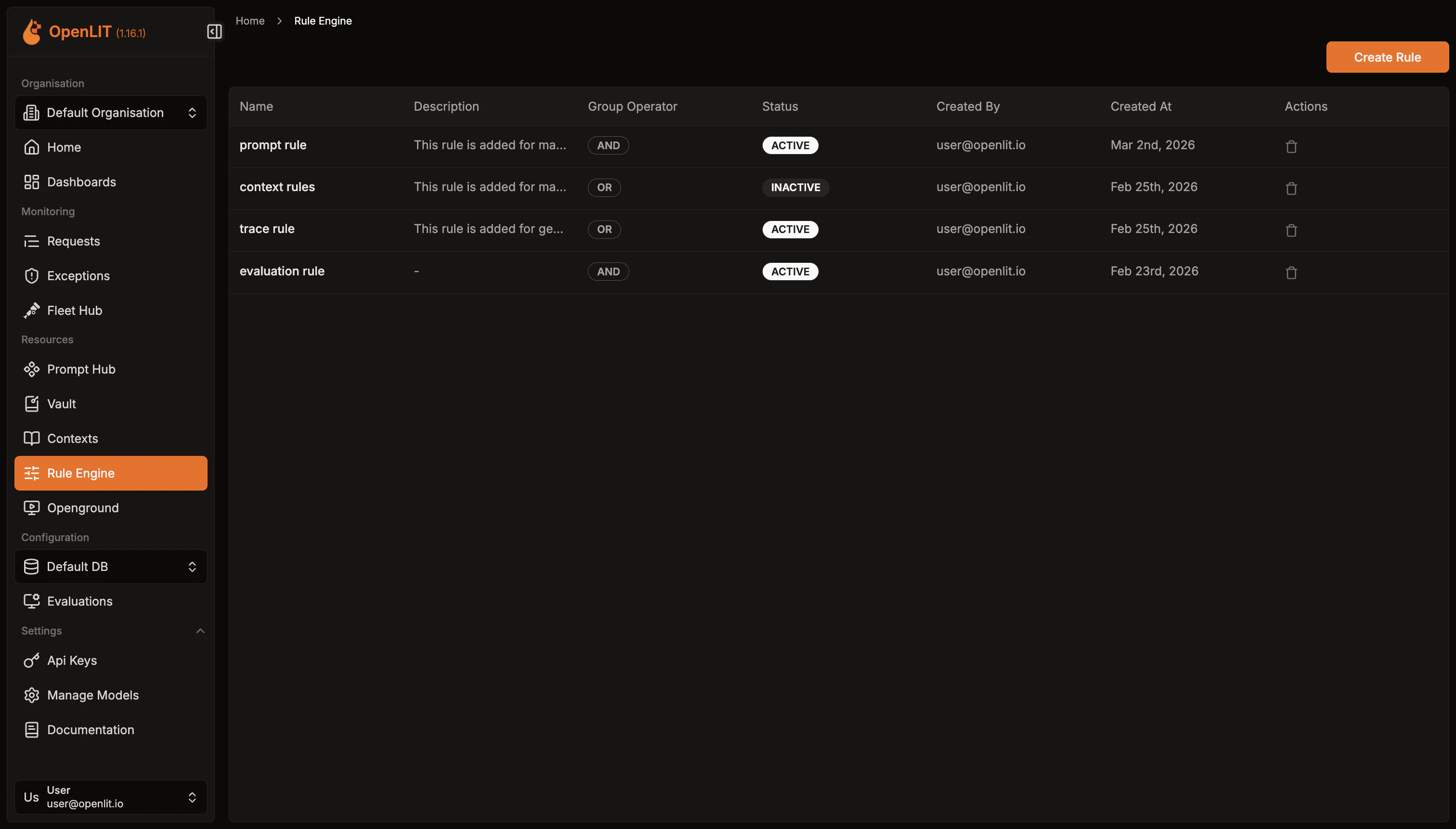
/rule-engine) shows every rule you’ve created, with columns for Name, Description, Group Operator (badge), Status (Active/Inactive badge), Created By, Created At, and Actions. Clicking anywhere on a row opens that rule’s detail page.
Create a rule
Once your database connection is healthy, a Create Rule button appears on the list page. Clicking it opens a dialog - there’s no separate page for creating a rule. The dialog title is “Create a new rule” when opened from the list page. If you instead start from a Context or Prompt’s own page, the same dialog opens titled “Create rule and link to context” or “Create rule and link to prompt”, and pre-fills the link to that entity for you. The dialog has these fields:- Name - required, e.g. “High cost alert”.
- Description - optional, describing what the rule does.
- Group Operator - required. Choose “AND - all groups match” or “OR - any group matches” (default AND). This sets how the rule’s condition groups are combined once you add them - see Conditions.
- Status - required. Choose Active or Inactive (default Active). Only Active rules are ever evaluated.
The rule detail page
Opening a rule (/rule-engine/[id]) shows a Back button to return to the list, plus:
- A rule info card and the condition builder on the left.
- A Rule Preview card and an Associated Entities card, stacked on the right.
Delete a rule
From the list page, click the delete (trash) icon in a rule’s Actions column. You’ll be asked to confirm:Are you sure you want to delete this rule? Deleting this rule will also remove all its conditions and entity associations.Deleting a rule removes it entirely, along with its condition groups and any entity links - this can’t be undone.
Conditions
Build condition groups, pick fields and operators, and combine groups with AND/OR