> ## Documentation Index
> Fetch the complete documentation index at: https://docs.openlit.io/llms.txt
> Use this file to discover all available pages before exploring further.
# Data-source connectors
> Connect OpenLIT to ClickHouse and OpenPlait-backed observability backends — atomic connectors, signal bindings, and portable query adapters
**Data-source connectors** attach OpenLIT to observability backends for reading traces, logs, and metrics. Each connector is atomic: one Tempo instance, one Loki instance, one Prometheus endpoint.
Configure them from **Configuration → Connectors** (`/connectors`) or manage bindings from **Organisation → Project → Connectors**. Select the correct [project](/latest/openlit/organisation/projects) and [environment](/latest/openlit/organisation/environments) before adding or binding connectors.
Several read paths use portable [@openplait](https://github.com/openlit/openplait) adapters so query behavior stays consistent across backends. See the [Connectors overview](/latest/openlit/connectors/overview) for memory connectors and shared registry concepts.
## Mental model
```mermaid theme={"theme":{"light":"github-light","dark":"github-dark"}}
flowchart LR
subgraph org [Organisation]
proj[Project]
end
subgraph env [Environment]
bindT[traces binding]
bindL[logs binding]
bindM[metrics binding]
end
proj --> env
bindT --> C1[Connector A]
bindL --> C2[Connector B]
bindM --> C3[Connector C]
C1 --> Tempo[Tempo]
C2 --> Loki[Loki]
C3 --> Prom[Prometheus]
```
* **Atomic connectors** — never a multi-backend blob. One Tempo instance, one Loki instance, one Prometheus endpoint.
* **Signal routing** — each of traces / logs / metrics is bound independently. See [Signal routing](/latest/openlit/organisation/signal-routing).
* **Database Config** — ClickHouse lives as a Database Config and appears as the built-in connector. See [Database Config](/latest/openlit/organisation/database-config).
## Supported connectors (OpenLIT + OpenPlait)
These are the data-source connectors available in open-source OpenLIT. OpenPlait packages power the portable query adapters for ClickHouse, Tempo, Loki, Prometheus, and Jaeger.
### Built-in app store
| Connector | Package / implementation | Signals | What it's for |
| -------------- | ------------------------------------------------- | -------------------------------------- | --------------------------------------------------------------- |
| **ClickHouse** | Database Config + `@openplait/adapter-clickhouse` | traces, logs, metrics (+ intelligence) | Default store; full correlation, raw SQL, evals metadata, vault |
### External data-source connectors
| Connector | Package / implementation | Signals | What it's for |
| ----------------- | ------------------------------- | ------- | ----------------------------------------------------------------------------------------------------------------- |
| **Grafana Tempo** | `@openplait/adapter-tempo` | traces | TraceQL search, trace tree, span events |
| **Grafana Loki** | `@openplait/adapter-loki` | logs | LogQL logs; correlate by trace id / service |
| **Prometheus** | `@openplait/adapter-prometheus` | metrics | PromQL HTTP API (also works with Prometheus-compatible endpoints such as Mimir when you point at their query URL) |
| **Jaeger** | `@openplait/adapter-jaeger` | traces | Jaeger Query HTTP API; sampled in-process aggregates |
Prometheus-compatible APIs (for example Grafana Mimir's PromQL endpoint) use the **Prometheus** connector — there is no separate Mimir connector type in open-source OpenLIT.
## Capability matrix
| Connector | Signals | Trace tree | Span events | Server aggregation | Raw SQL | Cross-signal correlation |
| ---------- | --------------------- | ---------- | ----------- | ------------------ | ------- | ------------------------ |
| ClickHouse | traces, logs, metrics | Yes | Yes | Yes | Yes | Full |
| Tempo | traces | Yes | Yes | No\* | No | trace / span / service |
| Loki | logs | — | — | No | No | trace id, service |
| Prometheus | metrics | — | — | Yes | No | — |
| Jaeger | traces | Yes | Yes | No\* | No | trace / span / service |
\* Aggregate graphs are reconstructed in-process from a bounded sample of full traces when the backend cannot aggregate server-side.
## Add a Jaeger connector
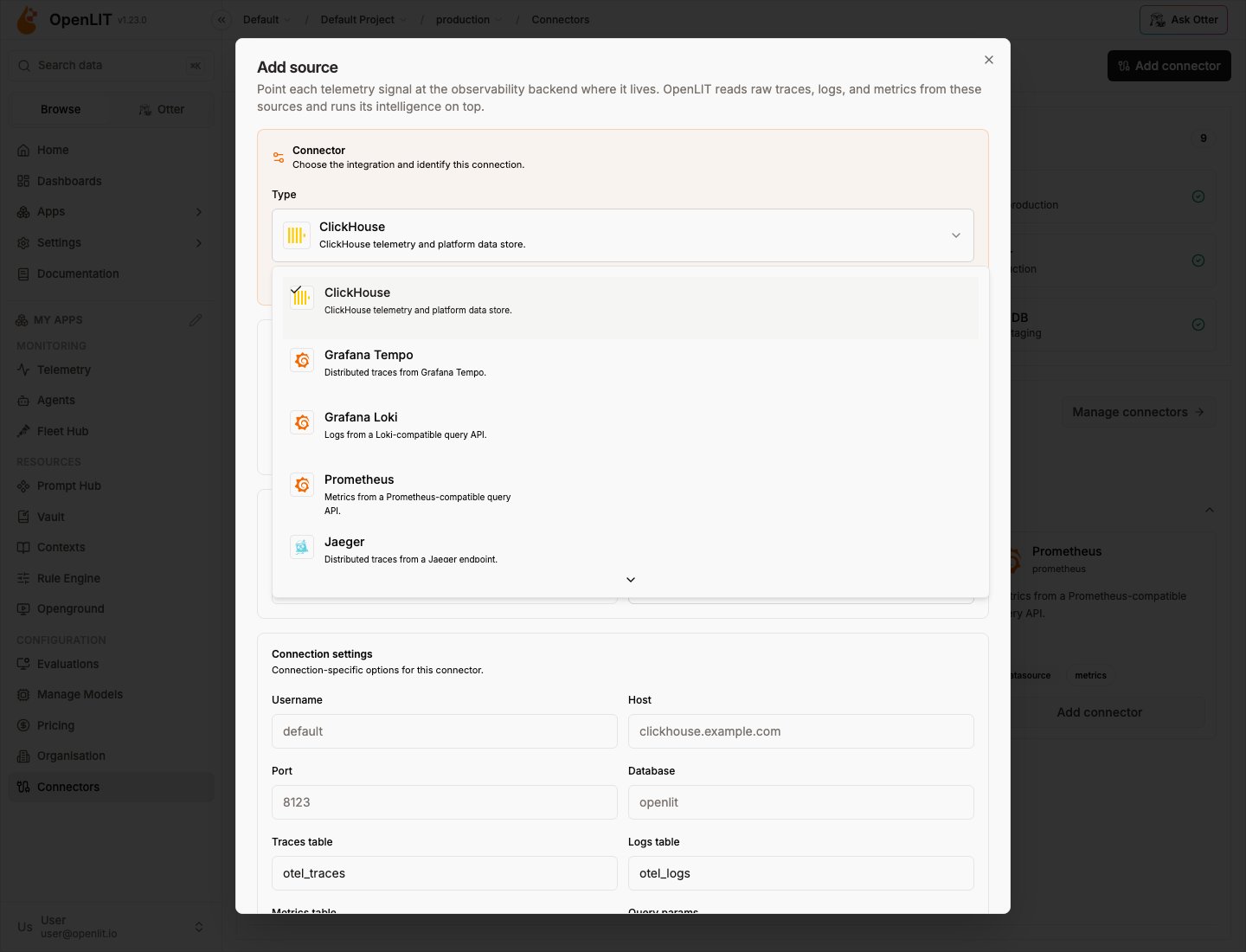 Use the header selectors to pick the [project](/latest/openlit/organisation/projects) and [environment](/latest/openlit/organisation/environments).
Go to **Configuration → Connectors** and choose **Add connector** / **Add source**.
Select **Jaeger** from the data-source connector list.
Set the Query URL (local all-in-one: `http://localhost:16686`) and auth if needed.
Bind **traces** to the connector under [signal routing](/latest/openlit/organisation/signal-routing).
Local demo credentials for seeded installs: email `user@openlit.io`, password `openlituser`. Jaeger all-in-one + seed script live in the OpenPlait `adapter-jaeger` integration folder.
## Actions you can take on a connector
The connector registry is designed so **actions** attach to a connector type. Today's data-source actions:
| Action | When to use it |
| ---------------------------------- | -------------------------------------------------------------------------- |
| **Add / edit connector** | Point OpenLIT at a new endpoint or rotate settings |
| **Store credentials in Vault** | API keys and tokens stay encrypted; decrypted only server-side |
| **Health check / test connection** | Confirm the endpoint is reachable with current auth |
| **Validate AI signal** | Confirm recent AI telemetry exists (`gen_ai.*` / OpenLIT markers) |
| **Bind signal** | Route traces, logs, or metrics to this connector for an environment |
| **Unbind / rebind** | Move a signal to another connector without deleting history in the backend |
| **Mark Database Config active** | Choose which ClickHouse app store the UI uses |
| **Share Database Config** | Grant edit / delete / re-share on a ClickHouse connection |
Enterprise audit logs record connector create/update/delete/test plus bind/unbind (with signal, environment, and previous source when switching).
## How OpenLIT finds AI telemetry
Backends hold all telemetry — not only AI. OpenLIT applies a layered **AI selector** so reads stay focused:
* Resource `telemetry.sdk.name = openlit`
* Resource `telemetry.distro.name = openlit-cli`
* Any `gen_ai.*` attribute
* `coding_agent.session.id`, or Claude Code session markers
* Known `coding_agent.*` span names
## Authentication cheat sheet
| Backend | Typical auth |
| -------------------------------------------------- | ----------------------------------------------------------------------------------------------------------------- |
| **Grafana Cloud** (Tempo / Loki) | Basic: instance ID + access policy token (`traces:read` / `logs:read`). Use **query** URLs from the Cloud Portal. |
| **Self-hosted Tempo / Loki / Prometheus / Jaeger** | None, Basic, or Bearer; optional tenant / `X-Scope-OrgID` |
| **ClickHouse** | Username / password on the Database Config |
## Security and reliability
* Endpoints validated (`http`/`https` only); credentials in URLs rejected; private/metadata SSRF targets blocked where applicable.
* Secrets live in Vault, redacted from errors, never logged.
* Per-source concurrency caps, query budgets, short-lived cache + in-flight de-dupe, and backoff on transient `429`/`5xx`.
## OpenPlait packages
OpenLIT wraps these npm packages for portable reads:
| npm package | Used for |
| ------------------------------- | ------------------------------- |
| `@openplait/core` | Query IR and normalized results |
| `@openplait/adapter-sdk` | Adapter contracts |
| `@openplait/adapter-clickhouse` | ClickHouse / OTel |
| `@openplait/adapter-tempo` | Tempo / TraceQL |
| `@openplait/adapter-loki` | Loki / LogQL |
| `@openplait/adapter-prometheus` | Prometheus / PromQL |
| `@openplait/adapter-jaeger` | Jaeger Query HTTP API |
| `@openplait/runtime` | Planning and execution helpers |
See the [OpenPlait repository](https://github.com/openlit/openplait) for publishing and adapter docs.
## Related
Claude, Mem0, and Zep for agent memory.
Bind traces, logs, and metrics independently.
Env vars → ClickHouse Database Config.
Shared connector model and project scope.
Use the header selectors to pick the [project](/latest/openlit/organisation/projects) and [environment](/latest/openlit/organisation/environments).
Go to **Configuration → Connectors** and choose **Add connector** / **Add source**.
Select **Jaeger** from the data-source connector list.
Set the Query URL (local all-in-one: `http://localhost:16686`) and auth if needed.
Bind **traces** to the connector under [signal routing](/latest/openlit/organisation/signal-routing).
Local demo credentials for seeded installs: email `user@openlit.io`, password `openlituser`. Jaeger all-in-one + seed script live in the OpenPlait `adapter-jaeger` integration folder.
## Actions you can take on a connector
The connector registry is designed so **actions** attach to a connector type. Today's data-source actions:
| Action | When to use it |
| ---------------------------------- | -------------------------------------------------------------------------- |
| **Add / edit connector** | Point OpenLIT at a new endpoint or rotate settings |
| **Store credentials in Vault** | API keys and tokens stay encrypted; decrypted only server-side |
| **Health check / test connection** | Confirm the endpoint is reachable with current auth |
| **Validate AI signal** | Confirm recent AI telemetry exists (`gen_ai.*` / OpenLIT markers) |
| **Bind signal** | Route traces, logs, or metrics to this connector for an environment |
| **Unbind / rebind** | Move a signal to another connector without deleting history in the backend |
| **Mark Database Config active** | Choose which ClickHouse app store the UI uses |
| **Share Database Config** | Grant edit / delete / re-share on a ClickHouse connection |
Enterprise audit logs record connector create/update/delete/test plus bind/unbind (with signal, environment, and previous source when switching).
## How OpenLIT finds AI telemetry
Backends hold all telemetry — not only AI. OpenLIT applies a layered **AI selector** so reads stay focused:
* Resource `telemetry.sdk.name = openlit`
* Resource `telemetry.distro.name = openlit-cli`
* Any `gen_ai.*` attribute
* `coding_agent.session.id`, or Claude Code session markers
* Known `coding_agent.*` span names
## Authentication cheat sheet
| Backend | Typical auth |
| -------------------------------------------------- | ----------------------------------------------------------------------------------------------------------------- |
| **Grafana Cloud** (Tempo / Loki) | Basic: instance ID + access policy token (`traces:read` / `logs:read`). Use **query** URLs from the Cloud Portal. |
| **Self-hosted Tempo / Loki / Prometheus / Jaeger** | None, Basic, or Bearer; optional tenant / `X-Scope-OrgID` |
| **ClickHouse** | Username / password on the Database Config |
## Security and reliability
* Endpoints validated (`http`/`https` only); credentials in URLs rejected; private/metadata SSRF targets blocked where applicable.
* Secrets live in Vault, redacted from errors, never logged.
* Per-source concurrency caps, query budgets, short-lived cache + in-flight de-dupe, and backoff on transient `429`/`5xx`.
## OpenPlait packages
OpenLIT wraps these npm packages for portable reads:
| npm package | Used for |
| ------------------------------- | ------------------------------- |
| `@openplait/core` | Query IR and normalized results |
| `@openplait/adapter-sdk` | Adapter contracts |
| `@openplait/adapter-clickhouse` | ClickHouse / OTel |
| `@openplait/adapter-tempo` | Tempo / TraceQL |
| `@openplait/adapter-loki` | Loki / LogQL |
| `@openplait/adapter-prometheus` | Prometheus / PromQL |
| `@openplait/adapter-jaeger` | Jaeger Query HTTP API |
| `@openplait/runtime` | Planning and execution helpers |
See the [OpenPlait repository](https://github.com/openlit/openplait) for publishing and adapter docs.
## Related
Claude, Mem0, and Zep for agent memory.
Bind traces, logs, and metrics independently.
Env vars → ClickHouse Database Config.
Shared connector model and project scope.